

In short: In the first six weeks after birth your body heals: lochia (postpartum bleeding) is heavy at first and gradually eases, your perineum or caesarean wound heals, and around day 3 or 4 your breasts fill with milk. The essentials are absorbent maternity pads (not tampons), comfortable postpartum underwear, and a few items for gentle perineal and breast care.
Author: Eva Birsa, mum and co-founder of Evitas · Updated: 27 September 2026
While packing your hospital bag and newborn essentials, it is easy to forget about yourself. This guide covers what happens to your body during the postpartum period according to official health sources, a checklist with quantities, and the warning signs you should never wait out.
What happens to your body in the first 6 weeks after birth
Lochia (bleeding after birth)
- After a vaginal birth or a caesarean you will bleed from your vagina. It is quite heavy at first, then turns brownish and decreases until it stops. According to the NHS it usually stops after 6 to 8 weeks, but it can last longer.
- Use maternity or period pads, not tampons – at least until your postnatal check, because tampons could increase the risk of infection (NHS).
- You may feel period-like cramps (afterpains) while breastfeeding, and bleeding can get heavier during feeds.
- Change pads often and wash your hands before and after.
Perineum and stitches
- Stitches after a tear or episiotomy usually heal within about a month, and the pain mostly eases within 2–3 weeks (NHS).
- Wash the area every day with plain warm water and gently pat dry. Wipe from front to back.
- If peeing stings, pouring warm water over the area while and after you pee can help, as can drinking plenty of water (NHS).
- Cooling – for example ice or a cold pack wrapped in a towel – can ease pain and swelling (NHS).
- Pelvic floor exercises can help healing and reduce pressure on the stitches, says the NHS.
After a caesarean
- Keep the wound clean and dry every day. Non-dissolvable stitches or staples are usually removed after 5–7 days (NHS).
- You will still have lochia after a caesarean – use pads, not tampons.
- Avoid heavy lifting and strenuous activity for about 6 weeks; check with your doctor when you can drive and exercise again.
- Choose high-waisted underwear that does not press on the scar.
Breasts and milk coming in
- Around day 3 or 4 your breasts may feel tight and tender as they start producing milk (NHS).
- Sore or cracked nipples are often a sign that the latch needs adjusting – ask your midwife, health visitor or a breastfeeding counsellor for help.
- For a hot, painful, swollen or hard area in the breast, the NHS advises you to keep breastfeeding and use a cold compress (for example 10 minutes every hour). If it does not improve within 12–24 hours or you have a fever, contact a doctor.
For more on engorgement and blocked ducts, read Breast engorgement and blocked ducts: what helps, when to worry.
Emotions and rest
Feeling down, anxious or irritable for a few days after birth is very common (the “baby blues”). According to the NHS it usually passes within 2 weeks. If the feelings last longer, get worse or you are struggling to cope, ask for help.
Postnatal checks
The World Health Organization (WHO) recommends at least 24 hours of care after birth in a health facility and at least three further postnatal check-ups in the first six weeks. The American College of Obstetricians and Gynecologists (ACOG) recommends contact with your care provider within the first 3 weeks and a comprehensive postpartum visit no later than 12 weeks after birth. Follow the schedule of midwife visits and checks offered in your country.
Checklist: what you need after birth
Quantities are our practical starting point, not medical advice – every recovery is different. The NHS suggests packing two packs of super-absorbent pads for the hospital. You will find everything below in our postpartum care and pads and compresses collections.
| Product | Why | Hospital bag | At home (first weeks) |
|---|---|---|---|
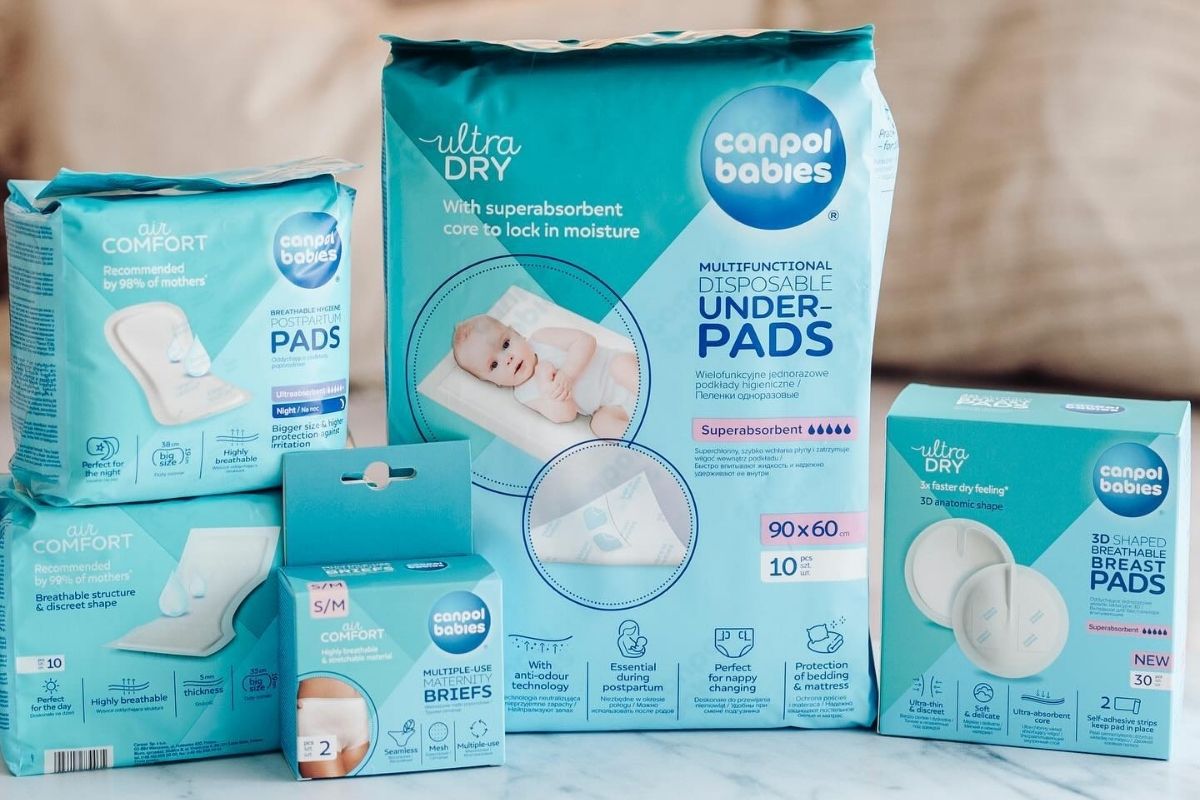
| Maternity pads Night | Long (38 cm), absorbent pads for the first days when bleeding is heaviest; an adhesive strip keeps them in mesh knickers. | 1–2 packs (10 pcs) | 1 pack for the first nights |
| 2-in-1 postpartum pants with pad (S/M, L/XL) | Pants and pad in one, absorbing up to 400 ml according to the manufacturer; the high waist does not press on a caesarean scar, and they tear open at the sides. | 1 pack (5 pcs) | optional for nights |
| Reusable mesh postpartum knickers (S/M, L/XL) | Breathable, seamless, high-waisted; hold large pads in place, hand-washable. | 2 packs (4 pcs) | the same, washed |
| Thinner pads with wings Day and Night | Once bleeding eases: 2.2 mm thin, 4 wings; Night is 42 cm long for lying down. | – | 2–4 packs |
| Peri bottle for perineal rinsing | For pouring warm water while and after you pee; 500 ml with a long foldable 17 cm nozzle, so you do not need to bend. | 1 | the same |
| Postpartum pad with cooling function | Activate the cooling by pressing – no freezer needed; also absorbs up to 250 ml. Medical device – follow the instructions. | 2–3 pcs | as needed |
| Hot-cold gel postpartum packs + hygienic covers | Reusable: cold for the perineum, piles or scar, warm for afterpains (according to the manufacturer). Comes with 12 disposable covers. | – | 1 set + covers |
| Multi-purpose underpads 90 × 60 cm | Protect the bed at night; later handy for nappy changes. | 2–3 pcs | 1 pack |
| Lanolin nipple cream | 100% lanolin in a 7 g stick; according to the manufacturer it does not need to be wiped off before feeds. | 1 | the same |
| Disposable breast pads | Absorb leaking milk; each is individually wrapped. | 1 pack | as used |
| Hydrogel breast pads with lanolin | Cool and protect sore nipples between feeds (medical device). | optional | if needed |
| Hot-cold breast gel packs | Cold for engorged breasts; warm, according to the manufacturer, before feeding or pumping to help milk flow. | – | 1 set |
Also useful: 5–6 pairs of comfortable knickers, 2–3 nursing bras, pyjamas that open at the front, a water bottle and fibre-rich food (fruit, vegetables, wholegrains), as your first poo after birth can be uncomfortable. See our breastfeeding and breast pads collections (reusable or disposable?) and the full Canpol babies range.
Nipple shields: only with expert advice
Silicone nipple shields (sizes S and M/L) can temporarily protect very sore nipples, but they do not fix the cause, which is often the latch. Use them after talking to your midwife or a breastfeeding counsellor.
When to get medical help straight away
The NHS lists signs that mean you should contact your midwife, health visitor or doctor straight away – for very heavy bleeding, chest pain or difficulty breathing call 112 (999 in the UK):
- sudden or very heavy vaginal bleeding, possibly with feeling faint or a racing heart;
- passing large blood clots;
- a high temperature, or a tender or painful tummy;
- foul-smelling lochia;
- pain, swelling or redness in the calf of one leg;
- chest pain or difficulty breathing;
- a bad headache, changes in vision or vomiting;
- a perineal or caesarean wound that becomes more red, swollen or painful, or leaks pus;
- a hot, painful breast with fever that does not improve within 12–24 hours;
- thoughts of harming yourself or your baby – get help immediately.
FAQ
How long does bleeding last after birth?
Usually a few weeks: heavy and red at first, then brownish and lighter. According to the NHS it usually stops after 6–8 weeks, but it can last longer.
How many maternity pads do I need?
For the hospital, the NHS suggests two packs of super-absorbent pads. For the first weeks at home, plan a few more packs of thinner pads as bleeding eases.
When can I use tampons again?
The NHS advises waiting until after your 6-week postnatal check, as tampons could increase the risk of infection.
Mesh knickers or 2-in-1 postpartum pants?
Mesh knickers are washable and hold a separate pad that you change as needed. 2-in-1 pants have a built-in pad and are handy for the first nights or after a caesarean. Many mums use both.
How can I ease perineal pain?
Cooling (always wrapped in a cloth or cover), pouring warm water while you pee, fresh air, pelvic floor exercises and painkillers agreed with your doctor can all help. If pain does not ease or gets worse, have the wound checked.
When is the postnatal check?
In many European countries the postnatal check with a GP, gynaecologist or midwife is around 6–8 weeks after birth. Do not wait if you notice any warning signs above.
Sources
- NHS – Your body after the birth
- NHS – Early days (bleeding after birth)
- NHS – Episiotomy and perineal tears
- NHS – Caesarean section: recovery
- NHS – Mastitis
- NHS – Postnatal depression
- WHO – Postnatal care recommendations (2022)
- ACOG – Redesigning postpartum care
This content is for information only and does not replace advice from your doctor or midwife. Product details are based on the manufacturer's descriptions.



