

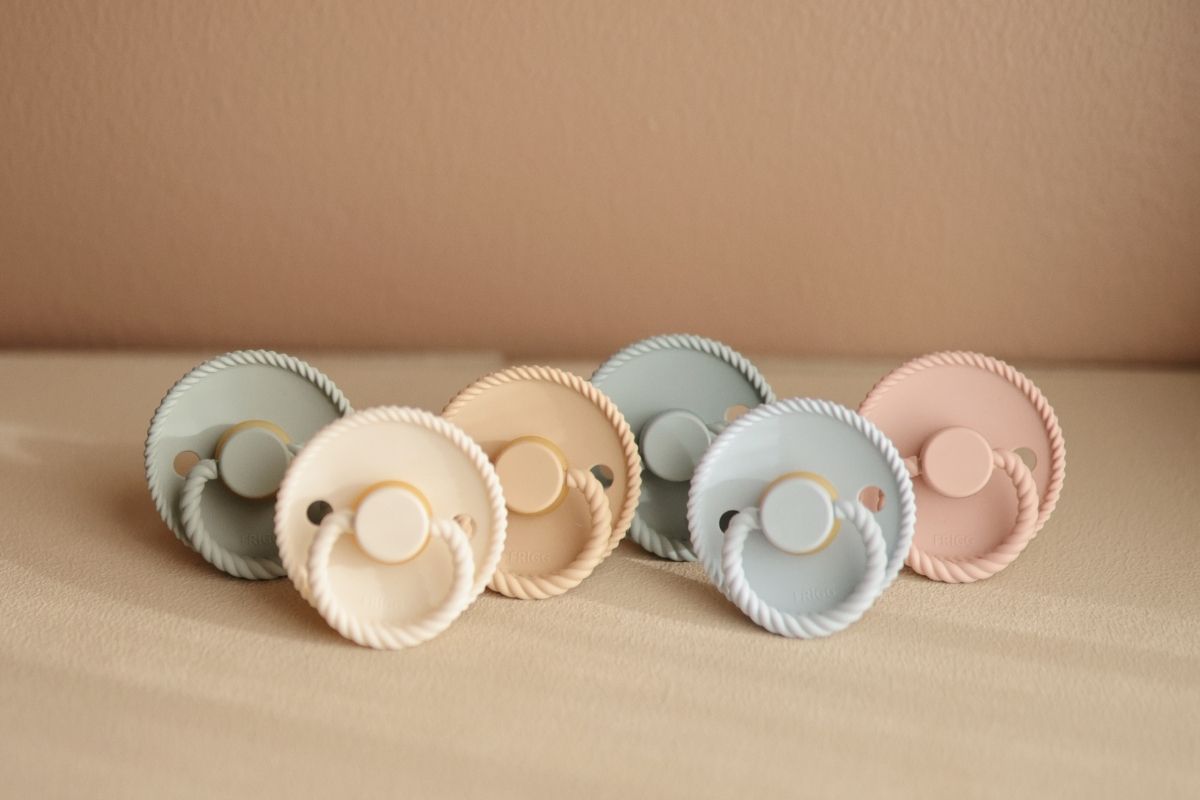
In short: A natural rubber (latex) nipple is softer and more flexible, but wears out faster and is not suitable if there is a latex allergy. Medical-grade silicone lasts longer, has no smell and is easier to clean, but feels slightly firmer. Even more important than the material are a safe pacifier (EN 1400 standard), regular checks and replacement, and the right time to introduce it.
Author: Eva Birsa, mum and co-founder of Evitas · Updated: 27 September 2026
The two materials are very different, so there is no single answer for every baby. Below is a comparison to help you choose, plus tips for safe use. We use FRIGG pacifiers, which come in both materials, as an example; for FRIGG sizes and nipple shapes see 6 key facts about FRIGG pacifiers.
Latex vs silicone at a glance
| Natural rubber (latex) | Medical-grade silicone | |
|---|---|---|
| Origin | natural material from rubber tree sap | synthetic, highly purified material |
| Look | yellowish brown | clear or translucent white |
| Feel | soft, flexible, closer to skin | smooth, slightly firmer |
| Smell and taste | faint characteristic smell | neutral |
| Allergies | not suitable with latex allergy | suitable with latex allergy |
| Durability | ages faster (light, heat, saliva) | keeps its shape longer |
| Cleaning | more demanding, surface can get sticky | easy, smooth surface |

When to choose latex and when silicone?
Natural rubber pacifier
Choose it if your baby prefers a soft, flexible nipple. Many parents try it first because it feels closer to skin. See our natural rubber pacifiers.
Silicone pacifier
Choose it if someone in the family has a latex allergy, if you want longer durability and easier cleaning, or if your baby dislikes the smell of rubber. See our silicone pacifiers.
Latex allergy
Latex allergy is uncommon in babies, but if it runs in the family, choose silicone. If redness, a rash or swelling appears around the mouth while using a latex pacifier, stop using it and talk to your paediatrician.
Durability, storage and replacement
- Latex stretches, swells or turns sticky over time. Store it somewhere dry and dark at room temperature, never in the sun or on a windowsill.
- Silicone keeps its shape longer, but teeth can pierce it – small cuts are dangerous because a piece of the nipple could tear off.
- Pull the nipple and inspect it before every use. If you see cracks, cuts, discolouration or a change in shape, throw the pacifier away straight away.
- Replace pacifiers regularly whatever the material – FRIGG recommends every 4–8 weeks of use.
- Never dip a pacifier in honey, sugar or medicine. Clean it according to the manufacturer’s instructions.
What to check for pacifier safety
- EN 1400: the European safety standard for soothers (strength, shield size, ventilation holes). Check the packaging to make sure the pacifier complies.
- Secure parts: the nipple must be firmly attached to the shield. FRIGG uses its Click-lock® system, where the parts click together, and every pacifier is mechanically tested during production.
- Right size: choose the size for your child’s age.
- No cords: never tie a pacifier around the neck, to a hand or to the cot. Use only a short pacifier clip that meets EN 12586, and only while your baby is awake and supervised – never during sleep.
Pacifiers and breastfeeding
- If you are breastfeeding, wait until breastfeeding is well established – usually around 3–4 weeks (AAP, Lullaby Trust).
- Some research suggests that using a pacifier to settle your baby to sleep may lower the risk of SIDS (NHS). Offer it consistently for every sleep; if it falls out during sleep, there is no need to put it back (Lullaby Trust).
- Never force the pacifier and don’t use it in place of a feed when your baby is hungry.
- Gradually stopping the pacifier between 6 and 12 months is recommended (Lullaby Trust).
How to decide
The easiest way is to let your baby try both materials. The first pacifier set contains several pacifiers in different materials and nipple shapes, so you quickly see which one your baby likes. Browse all models in pacifiers.
Frequently asked questions
Is a latex or a silicone pacifier safer?
Both are safe if the pacifier meets EN 1400 and you check and replace it regularly. They differ in softness, durability and suitability for latex allergy.
What should I choose with a latex allergy?
A medical-grade silicone pacifier.
How often should I replace a pacifier?
Regularly – for FRIGG every 4–8 weeks of use, and immediately at any sign of wear.
When can I give a breastfed baby a pacifier?
Once breastfeeding is well established, usually at 3–4 weeks.
Why does a latex pacifier get sticky or bigger?
Natural rubber ages because of saliva, light and heat. It’s a sign that it’s time for a new one.
Sources
- The Lullaby Trust: Dummies
- AAP (HealthyChildren.org): Pacifiers and Thumb Sucking
- NHS: Reduce the risk of sudden infant death syndrome
- EN 1400 (soothers for babies and young children) and EN 12586 (soother holders)
- FRIGG: When to replace your pacifier
This content is for information only and does not replace advice from your paediatrician.



