

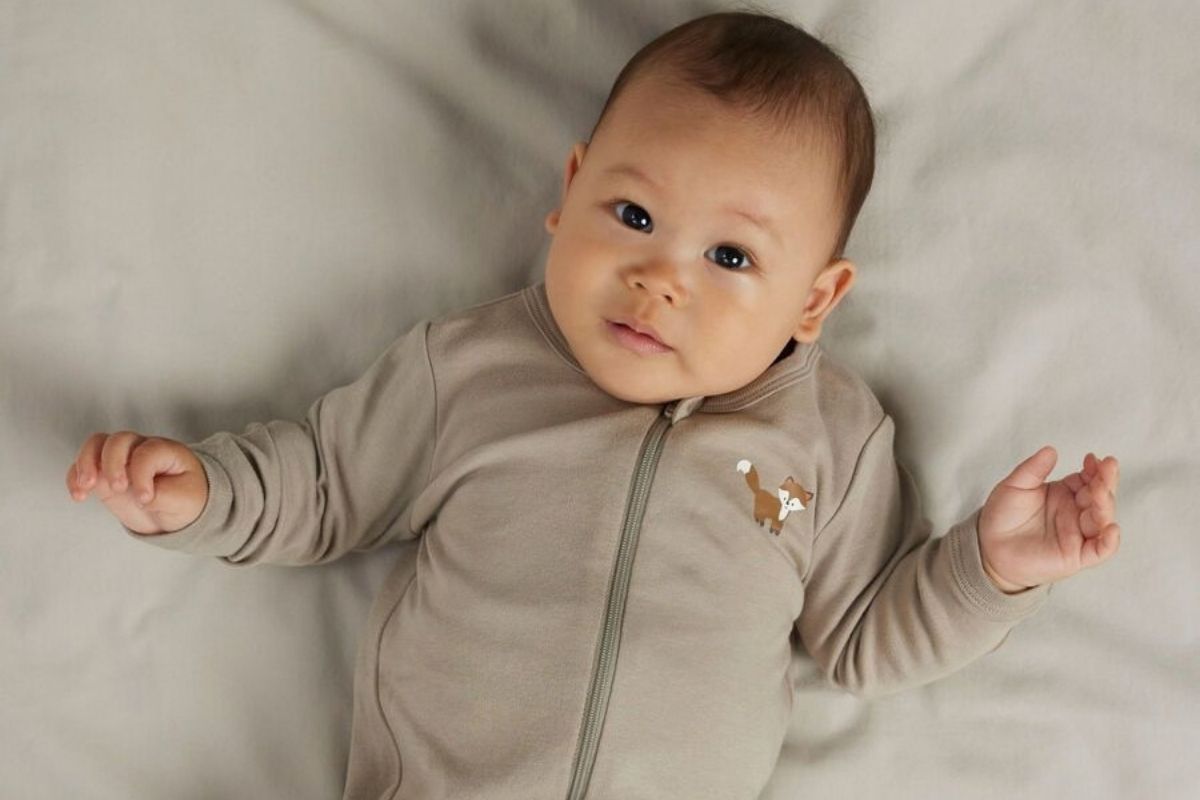
In short: In European baby clothes sizes, the number is the baby's body length in centimetres: size 56 fits a baby up to about 56 cm long. According to the Name it size chart, size 50 is for newborns, 62 for around 4 months and 74 for around 9 months. Size up when in doubt and buy only a few pieces in size 50.
Author: Eva Birsa, mum and co-founder of Evitas · Updated: 5 October 2026
How European baby clothes sizes work
Across most of continental Europe, baby clothes are sized 44, 50, 56, 62, 68, 74, 80, 86 and 92. The number is the body length (height) of the baby in centimetres that the garment is cut for. Size 62 therefore fits a baby measuring roughly 57 to 62 cm. The age on the label is only a guide, because babies grow at different rates.
UK and US sizing: British and American brands label baby clothes by age in months instead (for example "newborn", "0–3 months", "3–6 months"). As a rough guide, EU 56 is close to 0–3 months, 62–68 to 3–6 months and 74 to 6–9 months, but always compare the length given in each brand's size chart.
Baby clothes size chart by age
| EU size | Approx. age | Body length | Approx. weight* |
|---|---|---|---|
| 44 | premature babies | up to ~46 cm | under ~3 kg |
| 50 | newborn (0 months) | up to ~50 cm | ~3–4 kg |
| 56 | ~2 months | 51–56 cm | ~4–5.5 kg |
| 62 | ~4 months | 57–62 cm | ~5.5–7 kg |
| 68 | ~6 months | 63–68 cm | ~7–8 kg |
| 74 | ~9 months | 69–74 cm | ~8–9 kg |
| 80 | ~12 months | 75–80 cm | ~9–10 kg |
| 86 | ~18 months | 81–86 cm | ~10–11.5 kg |
| 92 | ~2 years | 87–92 cm | ~11.5–13 kg |
Ages for sizes 50–92 come from the official Name it size guide; size 44 and the body-length ranges follow the general European convention (e.g. the C&A size chart). *Weight is approximate and based on the medians of the WHO child growth standards; body length, not weight or age, is what matters when choosing a size.
Baby hat sizes by head circumference
Hats are sized by head circumference in centimetres. In the Name it chart, 34–39 cm corresponds to roughly 0–2 months, 40–44 cm to 2–6 months and 45–47 cm to 6–12 months. Measure around the head just above the eyebrows and ears with a soft tape measure.
How to choose the right size
- Measure length, don't count months. If your baby is 60 cm long, size 62 will soon be tight, so choose 62 or even 68.
- Size up. Babies grow fast and in spurts in the first months; a slightly bigger bodysuit with rolled-up sleeves lasts longer than a tight one.
- Buy little in size 50. Many babies outgrow it within weeks and some are born too big for it. Keep most of your stock in sizes 56 and 62.
- Double sizes (e.g. 50/56, 62/68) are cut for two growth stages, so they are worn for longer.
- Fit varies between brands. When trying a new brand, check the manufacturer's size chart and the product description.
Planning by season: a baby born in October
When buying ahead, think about which size your baby will wear in each season. Based on the Name it chart, a baby born in October will roughly wear:
- October–November: size 50–56 (long-sleeved bodysuits, leggings, a hat, a warm pram suit),
- December–February: size 56–62 (winter clothes, a knitted cardigan, a warm hat),
- March–April: size 62–68 (layered in-between-season clothes),
- summer: size 74 (short-sleeved bodysuits, lighter clothes).
So this baby won't need winter clothes in size 74 — don't stock up on big winter pieces in advance. How to layer a baby for walks, the pushchair, the car seat and sleep in winter is covered in How to dress a baby in winter.
Baby clothes checklist for the first months: how many to buy
| Item | How many (approx.) | What to look for |
|---|---|---|
| Long-sleeved bodysuit | 4–6 | more in winter; an envelope neck or wrap style makes dressing easier |
| Short-sleeved bodysuit | 2–4 | more in summer; a base layer in winter |
| Leggings or trousers | 4–6 | soft, stretchy waistband |
| Pyjamas or sleepsuit | 3–4 | under a sleeping bag, no hat |
| Knitted cardigan | 1–2 | front opening so it doesn't go over the head |
| Hat | 1–2 | thin for mild days, warmer for winter; take it off indoors |
| Socks | 4–6 pairs | they go missing easily |
| Pram suit | 1 | for cold months; not under car seat harnesses and not for sleep |
The numbers depend on how often you do laundry. Around 6–8 bodysuits per size is usually enough; the full list (sleep, changing, bathing, travel) is in our newborn essentials checklist. The NHS notes that newborns don't need a huge variety of outfits in the first weeks.
Examples from the Name it collection
- Name it bodysuit Green Milieu (3-pack) in soft rib knit, with an envelope neck and poppers between the legs; sizes 50–74.
- Name it long-sleeved bodysuit Pure Cashmere (2-pack) has a wrap design, so you don't have to pull it over the head; made from a blend of organic and BCI cotton.
- Name it leggings Peyote Melange in organic cotton, modal and elastane (2x2 rib), with an elastic waistband; sizes 56–74.
- Name it knitted cardigan Peyote Melange in 100% organic cotton with wooden buttons; sizes 56–86.
- Name it knitted baby hat Walnut in head circumference sizes 34–39, 40–44 and 45–47 cm.
- Name it pyjamas Green Milieu (2-pack) in cotton, sizes 50–74.
- Name it Teddy pram suit in soft plush teddy fabric with a cotton-blend lining, built-in fold-over mittens and double sizes 50/56, 62/68 and 74/80; an outer layer for the pram and walks.
See more in the collections Name it, baby clothes, baby bodysuits, leggings, cardigans and jumpers, pyjamas and sets and baby hats.
Knitwear, wool and cotton: what's the difference
- Cotton (jersey, rib knit) is soft and breathable and works well as a base layer, for bodysuits, leggings and pyjamas. The NHS recommends lightweight cotton next to the skin because it's breathable.
- Knitted cardigans and jumpers are the mid layer. Cotton knits are practical for everyday wear because they can be washed often.
- Wool and merino are usually warmer than cotton at the same thickness and need washing less often. Woolmark advises washing them with a wool detergent on a wool cycle or by hand, and drying them flat in the air.
A warmer fabric doesn't mean more layers: as a rule, a baby needs one more layer than you. For sleep, choose a sleeping bag with the right TOG rating — see our baby sleeping bag TOG chart.
Washing and shrinkage
- Wash new clothes before the first wear, ideally with a mild, fragrance-free detergent.
- Follow the care label. Cotton can shrink a little when washed at higher temperatures or tumble dried, so something that is already snug when you buy it may be too small after washing — another reason to size up.
- Wool and merino knits can shrink and felt if washed wrongly (hot water, heavy rubbing, tumble dryer). Use a wool cycle and dry flat.
- Pram suits and plush clothes: wash according to the label and close zips and poppers first.
Frequently asked questions
What size clothes should I buy for a newborn?
Size 50 or 56 for the first weeks, depending on length at birth. Buy only a few pieces in size 50 and most in sizes 56 and 62, as your baby will wear them for longer.
What does size 62 mean in baby clothes?
The number is the body length in centimetres. Size 62 fits a baby about 57–62 cm long, which is around 4 months in the Name it chart (roughly UK/US 3–6 months).
Should I buy baby clothes a size up?
Generally yes. Babies grow in spurts, cotton can shrink slightly in the wash and sleeves can be rolled up. The exception is sleepwear, which shouldn't be too loose.
How many bodysuits does a baby need?
Roughly 6–8 per size — more long-sleeved in winter, more short-sleeved in summer. If you wash daily, fewer will do.
How do I choose a baby hat size?
Measure the head circumference above the eyebrows and ears. With Name it, 34–39 cm is roughly 0–2 months, 40–44 cm 2–6 months and 45–47 cm 6–12 months.
What does a double size such as 62/68 mean?
The garment is cut to cover both sizes, i.e. a baby roughly 57–68 cm long. It is worn for longer, which is handy for pricier items such as a pram suit.
Sources
- Name it – Size guide
- C&A – Baby clothes sizes: chart by age & length
- WHO – Child growth standards: weight-for-age
- NHS – How to dress a newborn baby
- Woolmark – Wool care
Product details are taken from the product descriptions in our shop.



