

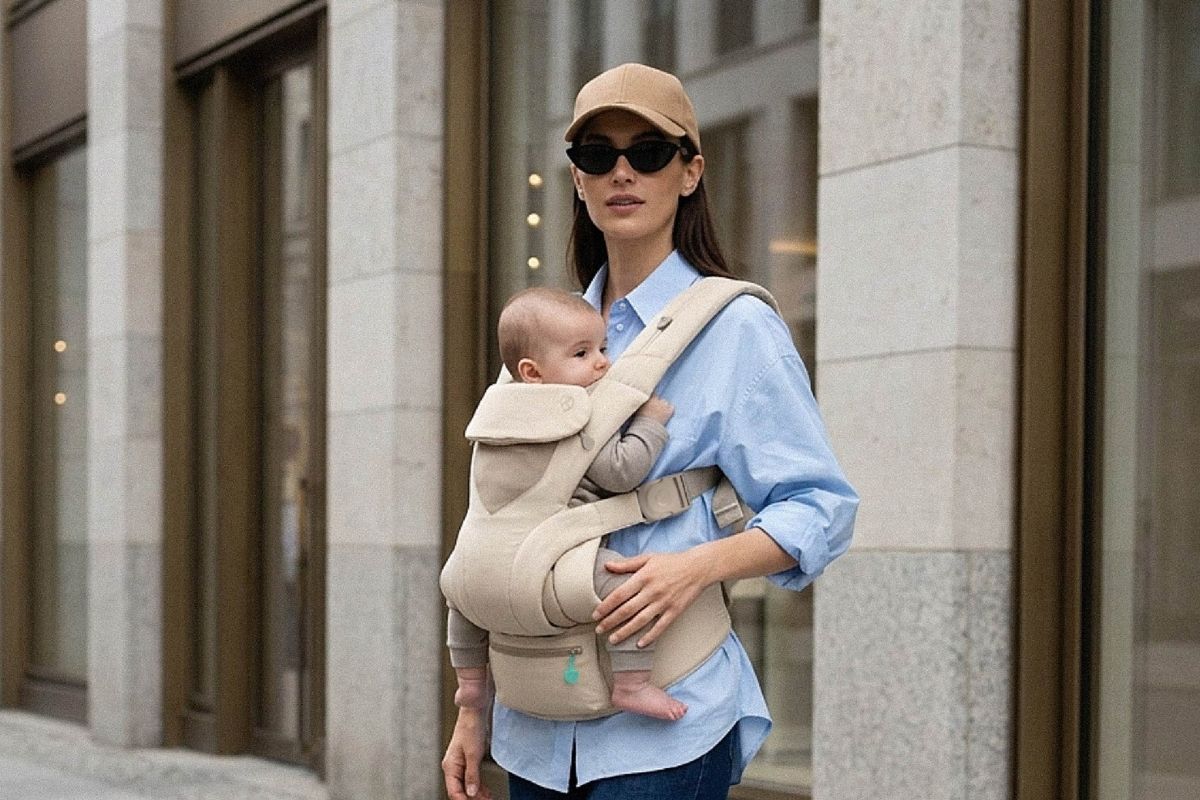
In short: A good baby carrier holds your baby in the ergonomic M-position – knees higher than the bottom, thighs supported to the knees, back naturally rounded. Most ergonomic carriers can be used from birth (from about 3.2 kg) if they have a newborn mode or insert. Follow the T.I.C.K.S. rule every time, and only carry facing out if the manufacturer allows it.
Author: Eva Birsa, mum and co-founder of Evitas · Updated: 27 Sep 2026
What is an ergonomic carrier and the M-position?
An ergonomic carrier doesn't hang your baby from the crotch – it supports them from knee to knee. The legs are spread around your body and bent, with the knees slightly higher than the bottom, so from the front the shape resembles the letter M. A newborn's back is naturally curved (C-shape), and the carrier shouldn't force it straight.
The International Hip Dysplasia Institute (IHDI) explains that when babies are carried, the hips should be spread apart with the thighs supported and the hips bent. According to the IHDI, a carrier that doesn't support the thigh to the knee may be inappropriate for prolonged use in the first months, when the hip joints are still loose. Short, occasional use is unlikely to affect hip development, but frequent, prolonged carrying can.
What does "hip-healthy" (IHDI) mean?
Some brands state that the IHDI has acknowledged their carrier as "hip-healthy". The IHDI itself stresses that it is not a certifying body and does not test products – the acknowledgement means the design meets its criteria for healthy hip positioning. It's a useful pointer, but no substitute for correct fitting. In our range, Ergobaby and Nuna Cudl, for example, mention it in their product descriptions. Koala Babycare also states IHDI recognition for its new Cuddle Carry.
Safe babywearing: the T.I.C.K.S. rule
The UK Sling Consortium, a group of sling manufacturers and retailers, created a simple rule that is also used by UK health organisations:
- T – Tight: the carrier or wrap should be tight enough to hug your baby close to you. Loose fabric lets the baby slump.
- I – In view at all times: you should always be able to see your baby's face by simply glancing down.
- C – Close enough to kiss: your baby's head should be as close to your chin as is comfortable.
- K – Keep chin off the chest: a baby should never be curled so their chin is forced onto their chest, as this can restrict breathing. Keep at least a finger's width under the chin.
- S – Supported back: the back is supported in a natural position, tummy against your body.
Take extra care with premature and low-birth-weight babies and babies with breathing problems – speak to your paediatrician or midwife before carrying. When bending down, support your baby with one hand, avoid overheating, and never use a carrier instead of a car seat or while cycling.
Types: carrier, woven wrap or stretchy wrap?
| Type | How it works | Pros | Best for |
|---|---|---|---|
| Ergonomic carrier (buckles) | padded waistband, shoulder straps and adjustable panel | quick to put on, spreads weight well, suits bigger toddlers | longer walks, carrying up to 15–20 kg |
| Stretchy wrap | long stretchy fabric you tie around yourself | very soft, snug hug for newborns | first months, roughly up to 9–11 kg |
| Woven wrap | long non-stretch fabric, many carries | very versatile, also for bigger babies | parents keen to learn tying |
| Hybrid (soft) carrier or band | softness of a wrap with buckles or a pull-on "T-shirt" design | no complicated tying, compact | newborns and babies, at home and short trips |
From what age can you use a baby carrier?
From birth – if the carrier is specifically designed for it. For most ergonomic carriers the minimum weight is around 3.2–3.5 kg. Some have a built-in newborn mode, others an insert. Check that the carrier supports the head and neck until your baby can hold them up.
- Newborn: always facing you, in the newborn position.
- Hip or back carry: once your baby has good head and trunk control and as the manufacturer states (e.g. Nuna Cudl Clik on the back from 9 months, Anex Whiz-hug from 8 months).
- Upper limit: from 11 kg for soft carriers to 15–20 kg for ergonomic carriers.
- Example of babywearing that grows with your child: in the first weeks, the soft Koala Cuddle Band 2 (2.2–15 kg), with the head support if needed; once your baby is heavier and more curious, the Koala Cuddle Carry ergonomic carrier (3.2–20.4 kg), which also allows facing-out and back carries.
Facing out: when and how?
Carrying facing out is only allowed in carriers designed for that position, and only once your baby meets the manufacturer's requirements – for example Ergobaby Embrace above 66 cm, Nuna Cudl Clik from 6 months, Joie Savvy Air from about 6 months or 9 kg. Some carriers (e.g. Ergobaby Adapt, Anex Whiz-hug) don't offer it at all. Your baby must have steady head control. When they get tired or fall asleep, turn them to face you. For the Koala Cuddle Carry, the manufacturer recommends facing out from around 5 months, once your baby has good trunk control.
Carrier comparison at Evitas
Data from product descriptions or manufacturers. Always read the instructions supplied with the carrier.
| Model | Type | Baby's weight | Carry positions | Features |
|---|---|---|---|---|
| Ergobaby Omni Classic Mesh | ergonomic | 3.2–20 kg, no insert | front (facing in and out), hip, back | breathable mesh, UPF 50+ hood |
| Ergobaby Omni Deluxe | ergonomic | 3.2–20.4 kg, no insert | all 4 positions | 6 pockets, reflective details |
| Ergobaby Adapt SoftFlex Mesh | ergonomic | 3.2–20.4 kg, no insert | front facing in, hip, back | waist 45–145 cm, IHDI acknowledged |
| Ergobaby Embrace / Embrace Soft Air Mesh | soft (hybrid) | 3.2–11.3 kg | newborn, facing in, facing out (above 66 cm) | no tying, compact |
| Ergobaby Aura Wrap | stretchy wrap | 3.6–11.3 kg | facing in | 490 cm long, TENCEL™ lyocell |
| Nuna Cudl Clik | ergonomic | birth to 16 kg (insert) | facing in, out from 6 m, back from 9 m | magnetic buckles, 1.09 kg, IHDI acknowledged |
| Nuna Cudl Deux | ergonomic | birth to 16 kg | 4 positions | interchangeable mesh and cotton panels |
| Cybex Amya | ergonomic | 3.2–15 kg | 4 positions | self-adjusting, 0.76 kg |
| Cybex Laya | soft (self-adjusting) | 3.2–15 kg | as per manufacturer's instructions | stretch fabric, kangaroo pocket, 0.88 kg |
| Joie Savvy Air | ergonomic | 3.5–15 kg (insert up to 6.5 kg) | facing in, out from ~6 m, back | AutoClick™ magnetic buckles |
| Anex Whiz-hug | ergonomic | 3.2–15 kg | facing in, back from 8 m | UPF 50+, EN 13209-2 |
| Koala Babycare Cuddle Carry | ergonomic | 3.2–20.4 kg (up to ~48 months) | facing in, facing out (from ~5 months), back | magnetic buckles, Velcro width adjustment, UPF 50+ hood, IHDI recognition |
| Koala Babycare Cuddle Band 2 | band (hybrid) | 2.2–15 kg | 2 modes | pull on like a T-shirt, organic cotton |
See all models in our baby carriers category.
New: Koala Babycare Cuddle Carry
The Koala Babycare Cuddle Carry is an ergonomic carrier with magnetic buckles for children from 3.2 to 20.4 kg (roughly up to 48 months). It offers three positions: front facing in, front facing out and back carry. Velcro panels let you adjust the width to your child's size, and it has built-in head and neck support, a UPF 50+ hood and a pocket. According to the manufacturer, its patented design keeps the legs in the M-position even when facing out. Available in beige, light green and light grey.
Koala Cuddle Band 2 and head support
The Koala Cuddle Band 2 is a soft band you pull on like a T-shirt – no long fabric to tie (2.2–15 kg, 97% organic cotton). For newborns who can't hold their head up yet, there is the Koala head support (24 cm long), which you slip into the band right behind your baby's neck. Even with the support, keep checking that the face is visible and the chin off the chest (T.I.C.K.S.).
What else to check before you buy
- Fit for both parents: waistband and strap range (e.g. Cybex Amya 70.5–186 cm, Nuna Cudl 58–147 cm).
- Breathability: mesh is great in summer; dress your baby a little lighter, as your body keeps them warm too.
- Ease of use: magnetic buckles or pull-on designs make it easier to put on alone.
- Standard: check that the carrier is tested to the European standard EN 13209 (e.g. Nuna Cudl, Anex Whiz-hug).
- Washing: most carriers are machine washable at 30 °C.
A carrier is the perfect companion to a pushchair – read also UPPAbaby Vista V3 vs Cruz V3: differences and which pushchair to choose.
FAQ
From what age can I carry my baby in a carrier?
From birth, if the carrier is designed for newborns (usually from 3.2–3.5 kg) and set to newborn mode or used with the insert. A newborn always faces you.
Are baby carriers bad for the hips?
No, as long as the carrier holds your baby in the M-position – thighs supported to the knees, knees higher than the bottom. The IHDI mainly warns against narrow-based carriers where the legs dangle down.
When can my baby face out?
Only in a carrier designed for it, once your baby meets the manufacturer's requirements (around 6 months or a set height or weight for our models) and has steady head control.
How long can a baby stay in a carrier?
Follow the manufacturer's instructions and your baby's needs, and take breaks. Check the position regularly using T.I.C.K.S. so your baby can breathe freely and doesn't overheat.
Wrap or carrier – which is better for a newborn?
Both can be safe. A stretchy wrap or soft carrier feels lovely in the early months; a buckle carrier is quicker to put on and better suited once your baby gets heavier.
Sources
- International Hip Dysplasia Institute – Baby Carriers & Other Equipment
- International Hip Dysplasia Institute – Baby Carriers & Related Products
- National Child Mortality Database – Baby sling safety (T.I.C.K.S., UK Sling Consortium)
- BAPM – Baby sling and low birth weight safety messages
This content is for information only and does not replace advice from your paediatrician.



