

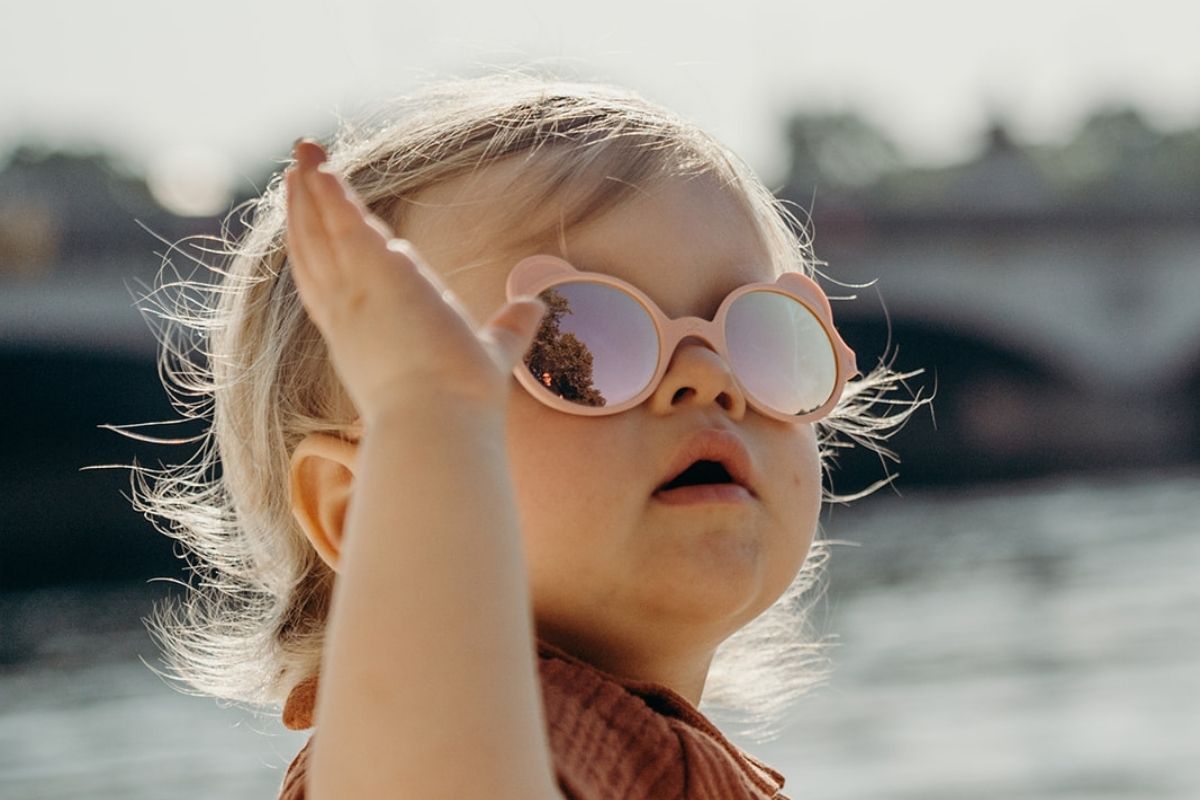
In short: Children's sunglasses should be labelled UV400 or 100% UV protection, have a category 3 filter for summer and outdoor play, and fit the width of your child's face. A darker lens does not in itself mean better protection. Babies under 6 months should mainly be kept in the shade, with a hat and a stroller sunshade.
Author: Eva Birsa, mum and co-founder of Evitas · Updated: 27 Sep 2026
Do children really need sunglasses?
Yes. The American Academy of Ophthalmology (AAO) points out that everyone is exposed to UV, including children, so babies and kids should wear hats and sunglasses in the sun. UV is stronger near water, on sand, in the mountains and on snow, and the sun gets through thin cloud too.
For babies under 6 months, the American Academy of Pediatrics (AAP) advises keeping them out of direct sunlight. If that is not possible, hats, umbrellas and well-fitting sunglasses that block at least 99% of UVA/UVB rays help.
UV400: the most important label
A UV400 label means the lens absorbs UV light up to 400 nm, which the AAO says is the same as 100% UV protection. The AAO stresses that a darker lens is not necessarily safer – only 100% UV protection does the job. Polarisation reduces glare (water, sand) but does not protect against UV on its own.
Filter categories 0–4 under EN ISO 12312-1
The filter category tells you how much visible light the lens lets through – how dark it is. It says nothing about UV protection, so always check for UV400 too.
| Category | Light transmission | When |
|---|---|---|
| 0 | over 80% | clear or very light tint |
| 1 | 43–80% | cloudy, weak sun |
| 2 | 18–43% | moderate sun |
| 3 | 8–18% | strong summer sun, beach – the most common choice for kids |
| 4 | 3–8% | very bright light (high mountains, snow, glaciers); not suitable for driving or road use |
Size by age
Sunglasses should cover the eyes and part of the sides of the face without pressing on the temples or nose. Measure your child's face width between the temples with a soft tape measure. Guide sizes from Ki ET LA's fitting chart:
| Age | Width between temples |
|---|---|
| 0–1 year | 94–100 mm |
| 1–2 years | 104–105 mm |
| 2–4 years | 110 mm |
| 4–6 years | 118 mm |
| 6–9 years | 122–125 mm |
What else to look for
- A flexible frame with no small parts: little ones pull, bend and chew their glasses.
- Shatterproof polycarbonate lenses.
- A strap for babies and toddlers so the glasses stay put – always with adult supervision.
- A wraparound shape so UV cannot get in from the sides.
- A case: replace glasses that are worn or scratched.
Example: Ki ET LA models
French brand Ki ET LA makes children's sunglasses with UV400 lenses. Models we stock:
| Model | Age | Lenses | Feature |
|---|---|---|---|
| DIABOLA 2.0 | 0–4 years (by size) | category 4, UV400 | reversible TPEE frame, strap |
| OURSON | 0–9 years (by size) | category 3, UV400 | TPEE frame, teddy ears, strap |
| WAZZ | 0–9 years (by size) | category 3, UV400 | rectangular shape, strap on smaller sizes |
| LION | toddlers | category 3, UV400 | lion shape, prescription lenses possible |
| WOAM | from 2 years to adults | category 3, UV400 | round retro shape, polycarbonate |
| ROZZ | children | category 3, polarised, UV400 | TR90 and TPEE, case |
| BUZZ | 4–9 years | category 3, polarised, UV400 | Janus de la Santé award |
| POP | 4–12 years | category 3, polarised, UV400 | arms flex up to 180° |
Find all models in our kids' sunglasses and Ki ET LA collections, together with sun hats and swimwear. Also read our guide Insect Bites, Jellyfish Stings and Ticks in Children: First Aid and browse sun creams.
FAQ
From what age can a child wear sunglasses?
Sizes are available from birth (0–1 year). The AAP recommends keeping babies under 6 months mainly in the shade; sunglasses are extra protection when the sun cannot be fully avoided.
Is category 4 better than category 3?
Not necessarily. Category 4 is darker and meant for very bright light (snow, high mountains); for everyday play and the beach, category 3 is enough. Both must be UV400.
Are polarised lenses essential?
No. Polarisation cuts glare off water and improves comfort; UV protection comes from the UV filter.
How do I know the size is right?
Measure the face width between the temples and compare it with the chart. The glasses should not slide down the nose or pinch at the sides.
Are cheap toy sunglasses good enough?
Only if they are clearly labelled UV400 or 100% UV protection and show a filter category. Otherwise, choose another pair.
Sources
- AAO – Tips for Choosing the Best Sunglasses
- AAO – The Sun, UV Light and Your Eyes
- AAO – Should infants wear sunglasses? (AAP advice)
- College of Optometrists – filter categories under EN ISO 12312-1
This content is for information only and does not replace advice from a paediatrician or eye doctor.



